Orrange ROt question (p)
Question and Answer from L4-M1
Question & Answer
Orrange ROt question (p)
Added: 2025-09-13 06:00:44Question Image
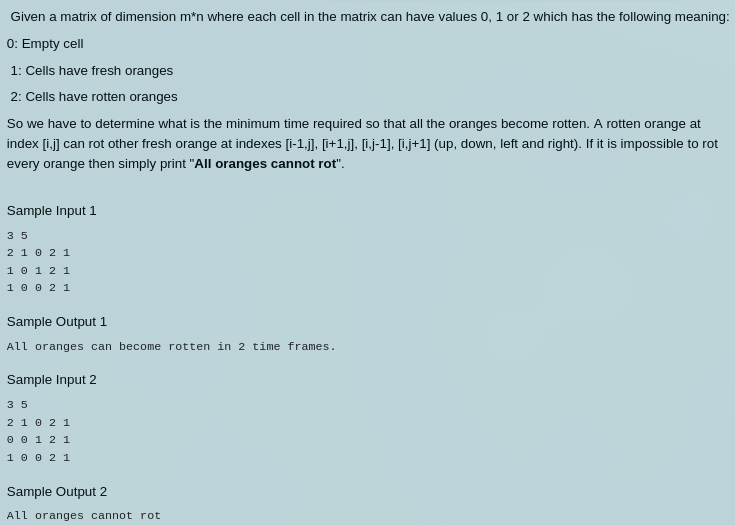
Answer
from collections import deque
import copy

def rotting_oranges(grid):
    """
    Calculates the minimum time required for all fresh oranges to become rotten in a grid.
    """
    if not grid or not grid[0]:
        return "All oranges can become rotten in 0 time frames."

    m = len(grid)
    n = len(grid[0])
    queue = deque()
    fresh_count = 0

    # Initialize the queue with rotten oranges and count fresh oranges
    for i in range(m):
        for j in range(n):
            if grid[i][j] == 2:
                queue.append((i, j, 0))
            elif grid[i][j] == 1:
                fresh_count += 1

    # If there are no fresh oranges, time required is 0
    if fresh_count == 0:
        return "All oranges can become rotten in 0 time frames."

    # If there are fresh oranges but no rotten ones, it's impossible
    if not queue:
        return "All oranges cannot rot"

    directions = [(0, 1), (0, -1), (1, 0), (-1, 0)]
    max_time = 0

    # Start BFS
    while queue:
        x, y, time = queue.popleft()

        for dx, dy in directions:
            nx, ny = x + dx, y + dy

            # Check for valid and fresh neighbors
            if 0 <= nx < m and 0 <= ny < n and grid[nx][ny] == 1:
                grid[nx][ny] = 2  # Rot the orange
                fresh_count -= 1
                max_time = max(max_time, time + 1)
                queue.append((nx, ny, time + 1))

    # Check if all fresh oranges were reached
    if fresh_count == 0:
        return f"All oranges can become rotten in {max_time} time frames."
    else:
        return "All oranges cannot rot"
m, n = map(int, input().split())
grid = []
for _ in range(m):
  row = list(map(int, input().split()))
  grid.append(row)

print(rotting_oranges(grid))